

Overview
The modern scientist is required to manage and track all their research samples, processes and procedures
across multiple instruments and controlling software systems all of which are obtained from a wide variety of different providers. This results in multiple handover points between systems as sample and data progress through a device-rich environment, all making it difficult to track samples and manage data. Potential errors are introduced each time a handover point is manually managed.
However, automating handover points is also problematic because instrumentation is different from one laboratory to the next, and bespoke integrations are expensive and time-consuming to create. HighRes Biosolutions and Mosaic by Cenevo solve the problem of multiple handovers between multiple devices and software by seamlessly streamlining your processes, integrating sample tracking, and managing your workflows and data. Standard, modular Nucleus hardware, working in concert with Cellario and Mosaic software, enable you to take control of your science once again, creating sample-distributed workflows and managing data at levels that would please even the most discerning regulatory body.
Our partners at Cenevo will be showing a demo of the Cellario-Mosaic integration at our Monday Exhibitor Tutorial, Orchestration and Data Automation for the Intelligent Lab, on Monday, February – at SLAS2026 in Boston! Learn more about it here or add it to your event scheduler now!
Automation from HighRes Biosolutions
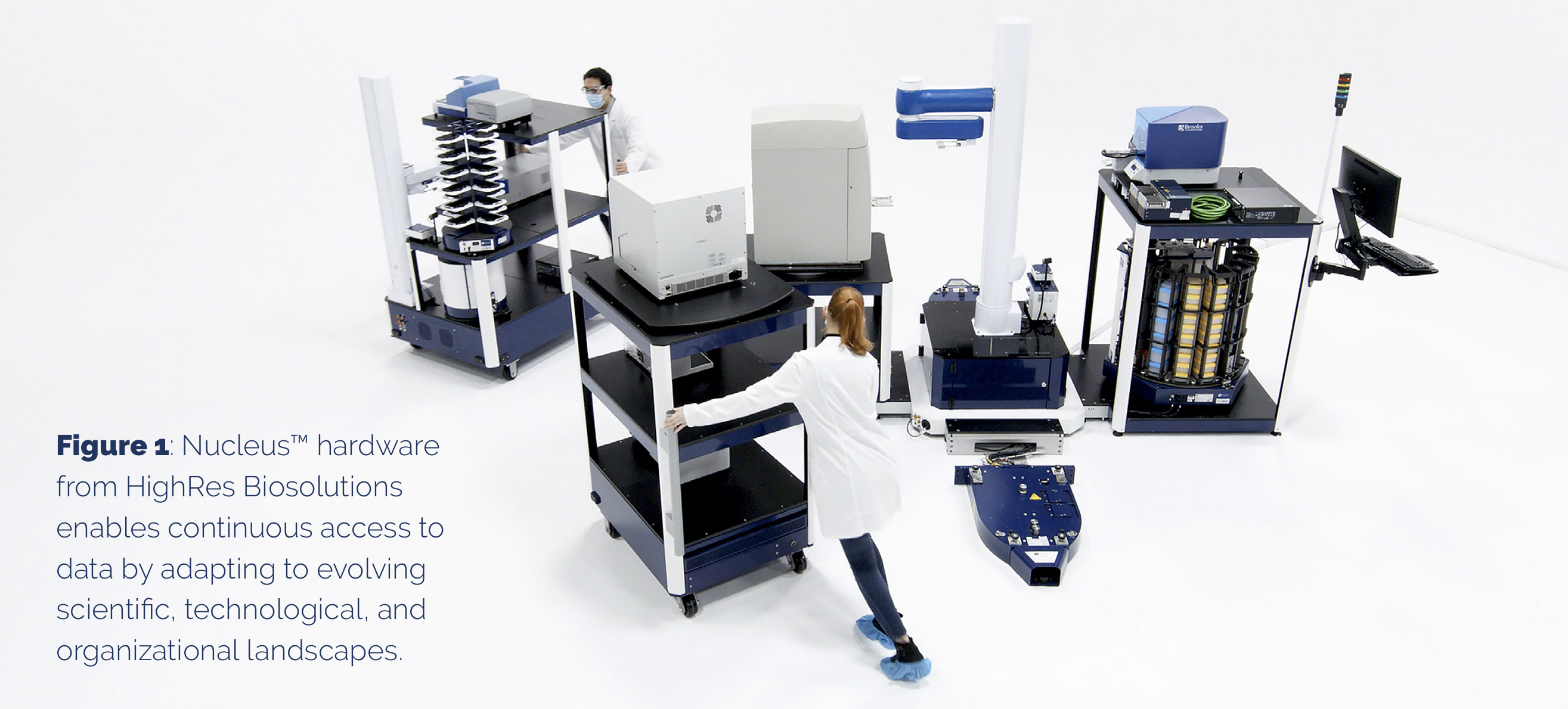
HighRes Biosolutions provides laboratory automation solutions for life science practitioners, from introductory automation to enterprise solutions, which enable your automation (Fig. 1). The Prime automated liquid hander (ALH) and other automated storage and work-enabling devices from HighRes can be used on their own or as part of a larger work cell to create adaptive and dynamic systems that can be configured on-the-fly to immediately adapt and scale to your requirements. CellarioScheduler is equally dynamic, controlling automated work cells that contain devices from any supplier, thus allowing scientists to choose the best tools for their application free of integration concerns. Industry leading design and total integrated hardware and software solutions are the hallmarks of the HighRes user experience.
Mosaic Software from Cenevo
Workflows created with Mosaic sample management software from Cenevo mimic the business processes that are performed on samples in a typical laboratory, and ALH operations can be captured in a variety of ways. The most secure of these is through direct integration of Mosaic with the ALH’s controlling software, which dramatically reduces the need for user intervention and eliminates potential sources of error during file manipulation. Mosaic software supports all typical ALH operations including, but not limited to, well-to-well transfer, compound serialization, plate replication, and transfer to and from microtubes/well plates. When coupled with an automated system software such as Cellario, scientists are given a powerful platform for managing daily operations, tracking sample movements, and meeting laboratory objectives.
Cellario-Mosaic Software Integration
The powerful workflow management features of Mosaic support Cellario processes which include serialization, replication (including serialization in combination with a subsequent replication), acoustic dose response, cherry picking, add control, and plate labelling. The Mosaic Machine Fulfillment integration interfaces with Cellario to enable order creation and workflow tracking. Mosaic Machine Fulfillment communicates directly with Cellario. This module feeds workflow (or job) processing parameters into Cellario for execution (Fig. 2).
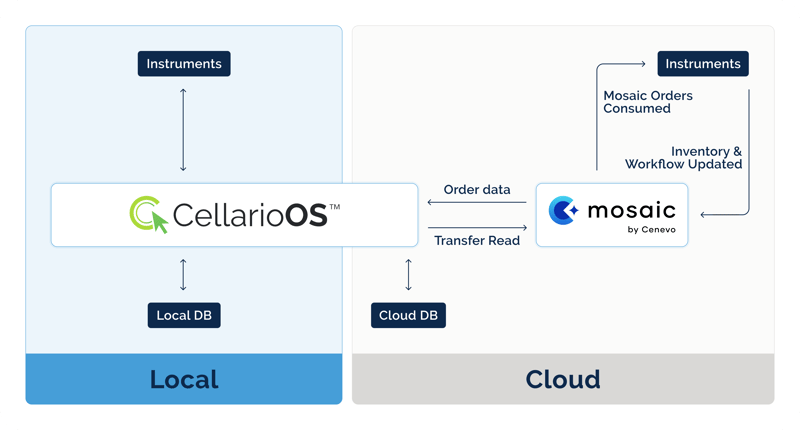
Figure 2. Cellario and Mosaic functionality is fully unified so that scientists can meet laboratory objectives without integration worries.
First, an operator uses the Machine Fulfillment web application to select an order(s) to fulfill from the Mosaic database – the desired Mosaic order output for a Cellario job and is guided through the job creation process. The job is created and sent to CellarioOS as an order. The CFM then creates an XML Job specification containing all the order parameters, including input, output, and control labware items and the specific transfers to be performed. The operator then fulfills the job using Cellario to control the required HighRes automation components.
Cellario tools are intuitive, enabling users to identify and manage production bottlenecks due to over-allocation of critical resources (such as Prime) and pause jobs to add higher-priority samples into production runs with ease. CellarioOS will notify Mosaic Machine Fulfillment of all notification and transfer information, which is used to update the Mosaic inventory and workflow. This includes transfers, transfer failures, and Echo survey data.
Mosaic Machine Fulfillment offers several distinct advantages compared to other machine integration fulfillment software. For example, all necessary workflow and transfer data are provided up-front to Cellario. This means that users can track assay control additions and labware labelling is highly configurable. This also ensures that network connectivity or server issues that are encountered in the middle of a run do not impede the work at hand. Cellario automatically performs a pre-run checklist and inventory scan to ensure the system has everything that it needs to produce the required output. Jobs are specified independently of the ALH device type, which allows maximum flexibility when work is processed in parallel across multiple ALH. A flexible Cellario template is automatically selected based on the output required and the parameters given. This is further refined to perform only the steps needed for fulfillment, significantly reducing the time needing to be spent to create and maintain multiple automation protocols on other systems.
Lastly, loosely coupled architecture results in significant cost savings in terms of configuration, testing, and maintenance. A well-defined Cellario web services interface avoids Cellario/Mosaic version incompatibilities, and the Mosaic Transfer Reader processes transfers only when a transfer is completed (successfully or otherwise).
Conclusion
Modern life science laboratories face significant challenges in managing research samples and data across multiple instruments and software systems from various providers. HighRes Biosolutions and Cenevo Software address these challenges through an integrated solution that combines HighRes's flexible laboratory automation hardware, including the Prime automated liquid handler, with Cenevo's Mosaic sample management software and HighRes's Cellario scheduling system.
The integration between Cellario and Mosaic by Cenevo, facilitated by the Cellario Fulfillment Module, enables seamless automation of laboratory workflows by allowing scientists to create, track, and execute complex sample management tasks without the typical handover errors and integration difficulties. This modular architecture provides laboratories with a scalable, adaptable platform that streamlines processes, maintains regulatory compliance, and allows scientists to focus on their research rather than managing multiple disconnected systems.
Interested in integrating Cellario and Mosaic by Cenevo in your laboratory?
Tell us about your project or contact Cenevo to schedule a consultation and discover how our seamless automation solution can eliminate manual handovers, reduce errors, and accelerate your research workflows.